


Rabbi Abraham Hochwald Z"l
Rabbi Abraham Hochwald Z"l, was Regional Rabbi of the Northern Rhine, received his semicha from Yeshivas Hebron (Jerusalem) and was a member of the Conference of German Rabbis and the Conference of European Rabbis. He started with his Kosher Certificates in 1980.
We offer an extensive knowledge of the structure of the German food industry, including raw materials and chemical substances.

Remark:
This list doesn't contain any wine, grape juice, cognac or brandy. They are all forbidden without the supervision of a Rabbinic Authority.
Beer:
German beer is because of purity regulations, generally kosher. A few marks are actually kosher certificated, like Herrenhausen or Clausthaler. Beer with fruit ingredients (from Belgium or Netherlands) needs to be checked individually.
Wine:
Wine, grape juice, and their derivatives are only under Rabbinical supervion kosher. You can't find them only in kosher stores.
| Kashrut | Aus | Sorte | Name |
|---|---|---|---|
| kosher | Italien | Liqueur | Amaretto |
| kosher - dairy | Süd Amerika | Not Specified | Amarula Cream |
| generally kosher | Anis | Arak/Pastis | |
| generally kosher | Zucker | Bacardi | |
| generally kosher | Gerste | Bear/Malt | |
| problem. | Frankreich | Verschiedene Kräuter | Benedictine |
| kosher | Holland | Liqueur | Bols |
| not kosher | Holland | Liqueur Apricot & Peach & Advocat | Bols |
| kosher, except Fantasia | Frankrecich | Apfel | Calvados |
| not kosher | Italien | Campari | |
| not kosher | Trauben | Champagne | |
| problem. | Kirschen | Cherry Brandy | |
| generally kosher | Apfel | Cider | |
| not kosher | Frankreich | Cognac Grand Marinier | |
| kosher, KF | Frankreich | Orangen | Cointreau |
| not kosher | Frankreich | Courroisier | |
| kosher | Scottland | Whisky und Honig | Drambuie |
| problem. | Eier | Egg Liqueur | |
| kosher | England | Weizen | Gin |
| not kosher | Trauben | Grape Juice | |
| problem. dairy | Irland | Liqueur | Irish Cream |
| kosher | Deutschland | Jägermeister | |
| kosher | Mexico | Kaffee | Kahlua |
| kosher | Deutschland | Kirschen | Kirschwasser |
| kosher | Germany | Liqueur Lemon | Limonci |
| kosher | Scottland | Whisky | Lochen-Ohra |
| kosher | Süd Amerika | Margarita | |
| not kosher | Italien | Martini | |
| kosher - dairy | Österreich | Sahne | Mozart Liqueur |
| problem. | Griechenland | Anis | Ouzo |
| not kosher | Frankreich | Pernod | |
| kosher | Denemark | Kirschen | Peter Heering |
| problem/dairy | Süd Amerika | Kokus | Pina Colada |
| not kosher | Trauben | Red/White Wine | |
| kosher | Jamaika oder Süd Amerika only! | Zuckerkannen | Rum |
| kosher | Italien | Anis | Sambuva |
| kosher dairy | Irland | Sahne | Sheridan's |
| kosher | Tchechien | Pflaumen | Slivovitz |
| kosher, with worm not kosher | Mexico | Agva | Tequilla |
| kosher | Süd Amerika | Tia Maria | |
| kosher | Rumenien | Pflaumen | Tzuika |
| not kosher | Bitterer Wein | Vermouth | |
| kosher | Scotland | Gerste | Whisky/Scotch |
| kosher | Weizen oder Kartoffel | Wodka |
The Kosher Alcohol List
Remark:
This list doesn't contain any wine, grape juice, cognac or brandy. They are all forbidden without the supervision of a Rabbinic Authority.
Beer:
German beer is because of purity regulations, generally kosher. A few marks are actually kosher certificated, like Herrenhausen or Clausthaler. Beer with fruit ingredients (from Belgium or Netherlands) needs to be checked individually.
Wine:
Wine, grape juice, and their derivatives are only under Rabbinical supervion kosher. You can't find them only in kosher stores.
| Kashrut | Aus | Sorte | Name |
|---|---|---|---|
| kosher | Italien | Liqueur | Amaretto |
| kosher - dairy | Süd Amerika | - | Amarula Cream |
| generally kosher | - | Anis | Arak/Pastis |
| generally kosher | - | Zucker | Bacardi |
| generally kosher | - | Gerste | Bear/Malt |
| problem. | Frankreich | Verschiedene Kräuter | Benedictine |
| kosher | Holland | Liqueur | Bols |
| not kosher | Holland | Liqueur Apricot & Peach & Advocat | Bols |
| kosher, except Fantasia | Frankrecich | Apfel | Calvados |
| not kosher | Italien | - | Campari |
| not kosher | - | Trauben | Champagne |
| problem. | - | Kirschen | Cherry Brandy |
| generally kosher | - | Apfel | Cider |
| not kosher | Frankreich | - | Cognac Grand Marinier |
| kosher, KF | Frankreich | Orangen | Cointreau |
| not kosher | Frankreich | - | Courroisier |
| kosher | Scottland | Whisky und Honig | Drambuie |
| problem. | - | Eier | Egg Liqueur |
| kosher | England | Weizen | Gin |
| not kosher | - | Trauben | Grape Juice |
| problem. dairy | Irland | Liqueur | Irish Cream |
| kosher | Deutschland | - | Jägermeister |
| kosher | Mexico | Kaffee | Kahlua |
| kosher | Deutschland | Kirschen | Kirschwasser |
| kosher | Deutschland | Lemon Liqueur | Limonci |
| kosher | Scottland | Whisky | Lochen-Ohra |
| kosher | Süd Amerika | Margarita | |
| not kosher | Italien | Martini | |
| kosher - dairy | Österreich | Sahne | Mozart Liqueur |
| problem. | Griechenland | Anis | Ouzo |
| not kosher | Frankreich | - | Pernod |
| kosher | Denemark | Kirschen | Peter Heering |
| problem/dairy | Süd Amerika | Kokus | Pina Colada |
| not kosher | - | Trauben | Red/White Wine |
| kosher | Jamaika oder Süd Amerika only! | Zuckerkannen | Rum |
| kosher | Italien | Anis | Sambuva |
| kosher dairy | Irland | Sahne | Sheridan's |
| kosher | Tchechien | Pflaumen | Slivovitz |
| kosher, with worm not kosher | Mexico | Agva | Tequilla |
| kosher | Süd Amerika | - | Tia Maria |
| kosher | Rumenien | Pflaumen | Tzuika |
| not kosher | - | Bitterer Wein | Vermouth |
| kosher | Scotland | Gerste | Whisky/Scotch |
| kosher | - | Weizen oder Kartoffel | Wodka |
One Specific Question in form
Basic Kosher Concepts
Kosher Information Page for the European Food Industry
Kosher:
Means suitable to human consumption according to the Jewish dietary laws. Every foodstuff must be Kosher certified.
Animals:
Only cows, sheep and goats are Kosher (have both Kosher marks: cleft footed and ruminant. Their milk is Kosher and their meat is only Kosher when they were slaughtered according to the Jewish ritual. Any other milk and meat are strictly forbidden.
Fowls:
Only poultry (hens, ducks, turkeys, geese and pigeons) are Kosher their eggs are Kosher and parve (see later) and their meat is only Kosher when it is slaughtered according to the Jewish ritual.
Fish:
Kosher fishes are those that have both Kosher marks: fins and scales. (e.g. salmon, carp, tuna, herring, trout mackerels etc.) All other fish, without fins as eels, sharks etc. are non-kosher. All sea-food e.g. lobsters, crabs, oysters etc. are strictly forbidden.
Insects:
All insects are forbidden. Flour has, therefore, to be sieved as well as some sorts of legumes e.g. rice, beans in order to prevent worms, etc.
Beverages:
a. All that originated from the grapevine (wine, grape juice) has to be produced only by Jews under strict supervision.
b. All derivatives of the grapevine must come only from Kosher wine (e.g. wine vinegar, tartaric acid, wine alcohol, brandy).
Pastry:
Needs to be, first, free from any non-kosher ingredients and also baked as 'Affiyat Ysroel'(Jewish baked), that means that the rabbi (or his assistant) operates himself, by lighting the oven, the entire baking process.
Meat - Parve - Diary:
The Jewish dietary laws require always a full separation between products that contain meat and those containing milk. It is strictly forbidden to eat or even to cook meat and milk together, therefore, every foodstuff must be labeled 'meat' or 'dairy' or 'parve'(means: neutral that can be consumed with meat or milk e.g. water, bread, fruits and vegetables.
Raw materials:
a. All raw-materials used in the food industry must be free from any animal or wine derived substances e.g. gelatin, animal fat, glycerol, stearin, emulsifiers, mono-di glycerides, polysorbates, tartaric acid, shellac anti-foams and anti-caking.
b. All products that were in contact with non-kosher materials or produced on the same line without kasherisation are non-kosher. This contact might be also in the steam system.
Kasherisation of production plants:
A plant where non-kosher products were produced can be 'kosherized' once the non-kosher ingredients were removed. This is done by a full cleaning process consisting of hot boiling water with steam and addition of strong chemicals. The entire procedure must be done under rabbinical supervision.
Passover:
a. During these festival days (that falls in end March - beginning April and lasts one week) it is forbidden to eat cereal products (leavened bread and pastry, flour, wheat starch, beverages and corn alcohol) as well as all products that have come in contact with them. It means that products like sweets, juices, baby food, oils and flavors must all be produced Kosher for Passover under Rabbinical supervision.
b. As a result must every product, that is meant to be used during the Passover days, be produced only under strict rabbinical supervision to ascertain that the production line was throughout cleaned from any residues and that the ingredients are free from any cereal derivatives. The finished products are then labeled as 'Kosher for Passover' and must carry a special Kosher certificate.
c. All products that contain legumes e.g. maize, soybean, rice, etc. In form of flour, oil or starch are only partly allowed for use on the Passover days. They must be labeled, therefore, Kosher for Passover 'Kitniyot'.
Super-Kosher:
These are products that have a high Kosher standard and are consumed by the ultra-Orthodox Jews. Usually, these product are produced only under strict Rabbinical supervision. When milk powder is used then it must be controlled from the milking process. It is called 'Chalav Yisroel'.
What is needed for a Kosher certificate?
A Kashrus expert 'Rabbi', has to inspect the production plant in order to find out if the products are kosher and to advise the company of the needed changes. A full list of all the products, ingredients and their suppliers has to be presented. Every such information must be reveled only if the inspecting rabbi commits himself to keep it as strictly confidential.
Who is authorized to issue a Kosher certificate?
For export to Israel:
a.The Chief Rabbinate of Israel must approve the Kosher certificate issued in abroad and only those European Rabbis and the Kosher organizations who enjoy its confidence are entitled to issue a Kosher certificate.
b. In addition, some of the Israeli importers require a super-kosher certificate, (see above) that is issued by the ultra- orthodox Kosher organization named Badaz, or by those European Rabbis who enjoy its confidence.
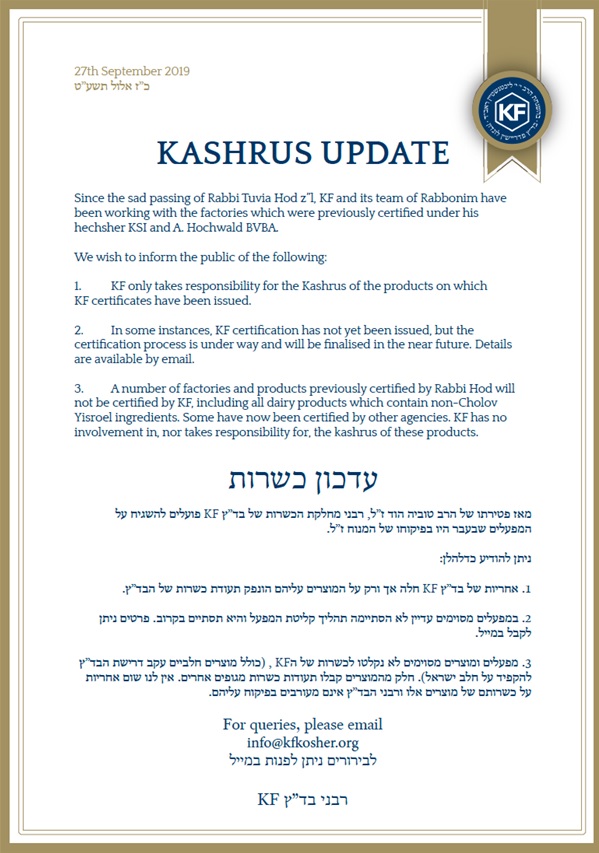
For export to the USA: There are in America several Kosher organizations. The main ones are: the Orthodox Union (O.U.), the Kosher Laboratories (O.K.), the Triangle-K, the Kof-K and the Star-K. The certification is done by the staff or the representatives of these organizations or by the European Rabbis who enjoy their confidence. A well-known European Kosher organization is the Kosher Federation of London (KF) that its certificates are fully accepted in the USA as well as in Israel and Europe.
Halal:
Means allowed to be eaten according to the Moslem dietary laws. Since the Islam forbids also the eating of food containing animal substances and alcohol, most of the kosher products can be certified also Halal.
Here you can find answers to question which are commonly asked.
If you do not find your question, feel free to contact us.
You can always send us your personal question.
Welcome to Kosher Germany
גישה ישירה למדריך הכשרות לתייר : זה קל וקול (cool) לשמור כשרות בחו"ל כשרות מזון (רגילה) לנוסעים לחו"ל - אירופה (מקומות ללא כשרות מוסדרת)
Quick access to the Travellers' Guide for Kosher Food in European Countries (with no kosher facilities)
Attention!
The bread "Eisweißbrot" of the company Mestemacher is Dairy and Kosher for Ochlei Halav Nochri.
Sincerely,
Kosher Germany
You can print the helpguides through the PRINT ICON.
The Kosher Guide can be purchased through the ORD.
Jewish Calendar
Rabbi ist das Koscher? ORD KoscherListe
Rabbi ist das Koscher? ORD Koscherliste
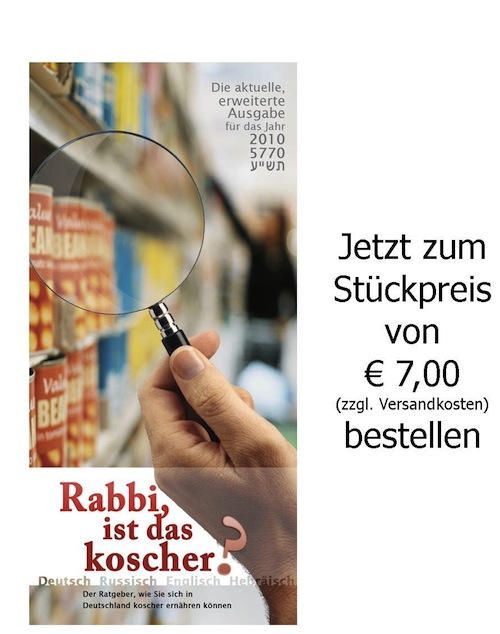
You can purchase the list of Kosher Products in Germany,
published by the ORD - Orthodoxe Rabbinerkonferenz Deutschland
at the following address:
Orthodoxe Rabbinerkonferenz Deutschland
Roonstrasse 50
50674 Köln
Germany
Fax.: +49-221-92156019
or on the website of Judaica 4 all : www.judaica4all.de
For Perview of the koscherliste, please visit: ORD Koscherliste

בס"ד, ד' אייר, התש"פ - 28.04.2020
לע"נ הרב טוביה אלחנן הוד-הוכוולד שצ"ל, נלב"ע כ"ז אדר ב', תשע"ט, ת.נ.צ.ב.ה
חוזר בנושא איסור "חדש" – תבואות קיץ בארצות אירופה תש"פ
אל כב' מרנן ורבנן היושבין על מידין, בכל אתר ואתר, אחדשה"ט,
כמידי שנה, הננו להביא לפניכם את המידע בנושא חשש "חדש" לשנה זו, בארצות אירופה. מידע זה מתייחס רק לשעורת קיץ. שעורה זו העוברת מאוחר יותר, תהליך של הנבטה (באמצעות לחות וחום נמוך) הופכת ללתת (מאלט), חומר הגלם ממנו מבשלים את הבירה.
יצויין שרוב החיטה באירופה היא מחיטת חורף ולא של קיץ.
כידוע, לצורך ייצור הלתת (מאלט) הנ"ל משתמשים אך ורק בשעורת קיץ. אנו מקבלים דו"ח מחברה גרמנית אשר עוסקת
במכירת הלתת למבשלות הבירה ובו עדכון מדוייק של זמני הזריעה. בד"כ הזריעה נעשית במהלך חודש מרץ עד תחילת
אפריל. כאשר מזג האוויר קשה, דהיינו: יש שלג רב או גשמים עזים ושטפונות, הזריעה מתאחרת ואם פסח יוצא מוקדם
יש בעייה של איסור "חדש". השעורה נקצרת בד"כ בחודש אוגוסט, תהליך ההנבטה ואח"כ ייצור הבירה והבשלתה
נמשכים כ 8- שבועות כך שלגבי הבירה החדשה שתגיע לשווקים בחודש נובמבר – חשוון תשפ"א, יש לדעת את מקור
הלתת (מאלט) וזמן הזריעה שמשתנה ממדינה למדינה. פסח יצא השנה יחסית מאוחר ולכן אין השנה חשש של "חדש".
נשוב ונזכיר שאין אנו נכנסים למחלוקת הידועה: האם יש להקפיד על "חדש" בחו"ל, כמובא בשו"ע יו"ד סי' רצ"ג ,מחלוקת הב"י והרמ"א
בספק ספיקא, מחלוקת הב"ח והט"ז, שיטת הגר"א מחד ושיטת ה"דברי חיים " מצאנז, מאידך, ידועים דברי המ"ב בסי'
תפ"ט סעיף י' ושם בס"ק מ"ה שיש להחמיר כשברור שהכל נזרע לאחר הפסח, עיי"ש . ונהרא נהרא ופשטיה.
ער"פ תש"פ חל השנה ב- 9 אפריל!
| המדינה | זמן זריעה עיקרי | הדין | הערות |
|---|---|---|---|
| אוסטריה | במהלך חודש מרץ-תחילת אפריל | ללא חשש "חדש" | הרוב נזרע לפני הפסח |
| אנגליה | במהלך חודש מרץ | ללא חשש "חדש" | הכל נזרע לפני הפסח |
| גרמניה | במהלך חודש מרץ | ללא חשש "חדש" |
הכל נזרע לפני הפסח |
| דנמרק | במהלך חודש מרץ - תחילת אפריל | ללא חשש "חדש" | הרוב נזרע לפני הפסח |
| הולנד | במהלך חודש מרץ | ללא חשש "חדש" | הכל נזרע לפני הפסח |
| הונגריה | במהלך חודש מרץ | ללא חשש "חדש" | הכל נזרע לפני הפסח |
| סלובקיה | במהלך חודש מרץ | ללא חשש "חדש" | הכל נזרע לפני הפסח |
| ספרד | במהלך חודש פברואר-מרץ | ללא חשש "חדש" | הכל נזרע לפני הפסח |
| סקוטלנד/אירלנד | במהלך חודש מרץ | ללא חשש "חדש" | הכל נזרע לפני הפסח |
| פולין | במהלך חודש מרץ | ללא חשש "חדש" | הכל נזרע לפני הפסח |
| פינלנד | אחר הפסח | חשש "חדש" | הכל נזרע אחר הפסח |
| צ'כיה | במהלך חודש מרץ | ללא חשש "חדש" | הכל נזרע לפני הפסח |
| צרפת | במהלך חודש פברואר -מרץ | ללא חשש "חדש" | הכל נזרע לפני הפסח |
| רוסיה | אין מידע | ||
| שבדיה | סוף חודש מרץ - תחילת אפריל | ללא חשש "חדש" | הרוב נזרע לפני הפסח |
More Articles...
- חוזר בנושא איסור "חדש" – תבואות קיץ בארצות אירופה תשע"ד
- חוזר בנושא איסור "חדש" – תבואות קיץ בארצות אירופה תשע"ה
- חוזר בנושא איסור "חדש" – תבואות קיץ בארצות אירופה תשע"ז
- חוזר בנושא איסור "חדש" – תבואות קיץ בארצות אירופה תשע"ח
- חוזר בנושא איסור "חדש" – תבואות קיץ בארצות אירופה תשע"ט
- חוזר בנושא איסור "חדש" – תבואות קיץ בארצות אירופה תשע"ט (2)
- חוזר בנושא איסור "חדש" – תבואות קיץ בארצות אירופה תשפ"א
- חוזר בנושא איסור "חדש" – תבואות קיץ בארצות אירופה תשפ"ג
- חוזר בנושא איסור "חדש" – תבואות קיץ בארצות אירופה תשפ"ד
- חוזר בנושא איסור "חדש" – תבואות קיץ בארצות אירופה תשפ"ה